Every time a client connects to your server, a small negotiation happens before a single byte of application data moves. That negotiation, the TLS handshake, is what makes encrypted web traffic possible. It's also at risk of being recorded. Not the content of your sessions, but the handshake itself. And that's enough. A well-resourced attacker doesn't need to break your encryption today. They collect the handshakes now, wait until quantum computing matures, then use it to decrypt everything they've stored. The attack is called "harvest now, decrypt later.”
This isn't a general hacker concern. The actors with the means to store encrypted traffic at scale (and eventually acquire the quantum computing resources to break it) are nation-states and large, well-resourced organizations. The other important detail: you can't tell it's happening. Passive traffic collection leaves no trace, and waiting isn't a viable posture.
In August 2024, NIST responded to this threat by finalizing its first post-quantum cryptography (PQC) standards: ML-KEM for key encapsulation, and ML-DSA, SLH-DSA, and FN-DSA for digital signatures.
This post covers what happens during a TLS handshake, why quantum computers threaten the key exchange step specifically, and how HAProxy can protect your traffic with hybrid post-quantum cryptography right now.
How does the TLS handshake work?
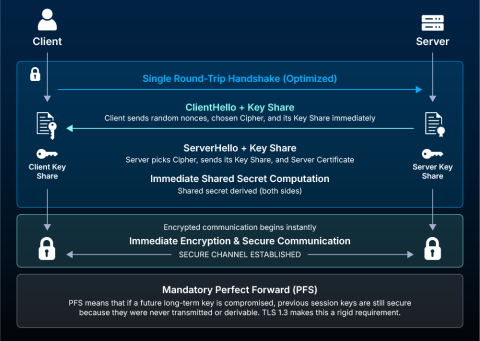
Every TLS connection begins with a handshake, a brief negotiation that establishes which cipher suite to use, authenticates the server, and derives the symmetric keys that protect the session. The cipher suite is the combination of algorithms and key lengths governing the session. The vulnerability that post-quantum cryptography addresses lives in one specific step of this process: the key exchange.
Modern TLS stacks, whether running 1.2 or 1.3, use ECDHE (Elliptic Curve Diffie-Hellman Ephemeral) for that key exchange. Both sides contribute a fresh random value; the shared secret is derived from both contributions and immediately discarded. The classical security of ECDHE rests on the hardness of the elliptic curve discrete logarithm problem, which is effectively unsolvable on classical hardware. It is not unsolvable for a quantum computer running Shor's Algorithm.
TLS 1.3 (shown below) improves on 1.2 in ways that matter for this discussion: it makes ECDHE mandatory by removing static RSA key exchange, reduces the handshake to a single round-trip, and adds support for hybrid post-quantum key exchange. It also makes Perfect Forward Secrecy mandatory by design — more on that, and its limits, shortly.
Hybrid PQC requires TLS 1.3 because the named groups extension that carries the post-quantum component isn't available in TLS 1.2.
More details about SSL/TLS stacks can be found in our State of SSL blog post.
Hybrid key exchange
You'll see references to "hybrid key exchange" throughout this post. It means combining a classical algorithm (ECDHE) with a post-quantum algorithm (ML-KEM, or Module Lattice Key Encapsulation Mechanism) and using both outputs to derive the shared secret. Neither algorithm alone is enough to reconstruct it. It's a fail-safe in either direction: if ML-KEM has an undiscovered flaw, ECDHE still holds. If ECDHE is broken by a quantum computer, ML-KEM still holds. The hybrid approach also maintains backward compatibility, so clients that don't support post-quantum curves will negotiate classical ECDHE automatically.
If you want a deeper look at the mechanics of TLS 1.3 and round-trip improvements, we covered that in our TLS 1.3 & 0-RTT blog post.
Why do quantum computers break TLS?
Modern TLS key exchange relies on two math problems that are easy to compute forward and nearly impossible to reverse on classical hardware.
RSA depends on integer factorization. Multiplying two primes together is trivial: 17 × 23 = 391. Working backward from 391 to find 17 and 23 is manageable. Doing that with 600+ digit numbers is effectively impossible for any classical computer. ECDHE depends on the elliptic curve discrete logarithm problem, a different but similarly hard-to-reverse operation.
A sufficiently powerful quantum computer running Shor's Algorithm changes this, and Shor's Algorithm can solve both integer factorization and discrete logarithm problems efficiently. That means RSA and ECDHE, the two key exchange mechanisms securing virtually all classical TLS deployments, become breakable.
Quantum computers powerful enough to do this don't exist yet. But the timeline is shorter than most assume; Google's cryptography migration timeline puts the window at years, not decades. And there's a threat that doesn't require waiting for them.
ML-KEM is built on the Module Learning With Errors (MLWE) problem: given a system of linear equations with small random errors deliberately introduced, recovering the original values is computationally intractable even for a quantum computer. It doesn't reduce to factorization or discrete logs, so Shor's Algorithm does not apply. NIST standardized ML-KEM in 2024 because lattice problems of this kind are believed to be hard for both classical and quantum computers. You may also see it referred to by its earlier name, CRYSTALS-Kyber, which is still common in documentation and tooling.
If you want an interactive look at how Shor's Algorithm transforms factoring into period finding, this demo is worth a few minutes.
Perfect Forward Secrecy (PFS) and its limits
Perfect Forward Secrecy (PFS) is a property of certain key exchange mechanisms. When PFS is in place, each TLS session uses a completely independent, ephemeral key. Ephemeral means the key is generated fresh for that session and discarded immediately after. It's never stored on disk, never reused.
The practical upside: if an attacker later compromises your server's private key, they can't decrypt past sessions. Each session's secret is gone once the session ends.
PFS in TLS comes from ephemeral Diffie-Hellman key exchanges, specifically ECDHE. Both sides contribute a fresh random value per session. Neither side's value is ever reused. TLS 1.3 mandates PFS by removing static key exchange options entirely, which is one of the reasons it's a meaningful improvement over TLS 1.2.
But PFS has a limit that quantum computing exposes.
Why Perfect Forward Secrecy doesn't fully solve the quantum threat
A well-resourced attacker doesn't need to break encryption today. The strategy is to record encrypted TLS traffic now and wait until a cryptographically-relevant quantum computer exists, then use Shor's Algorithm to break the classical key exchange retroactively, sometimes described as "harvest now, decrypt later." It's a practical threat for any traffic containing data with a long sensitive shelf life: medical records, government communications, intellectual property.
PFS doesn't change this calculus, because the threat it protects against (an attacker stealing a server's long-term private key) is a different threat model entirely. What Shor's Algorithm targets is the ephemeral key exchange itself, by solving the discrete logarithm problem against the recorded handshake. That handshake was transmitted in plaintext and is straightforward to capture passively, without any access to the server. Forward secrecy was designed for a world where breaking the key exchange was computationally out of reach, and that assumption no longer holds.
Hybrid post-quantum key exchange addresses this directly. By combining ECDHE with ML-KEM, breaking the shared secret requires defeating both algorithms simultaneously, and Shor's Algorithm currently cannot be used against the lattice-based component.
Configuring hybrid post-quantum cryptography in HAProxy
HAProxy Enterprise 3.2+ and HAProxy Community 3.3+ support hybrid post-quantum cryptography natively. This works because both versions ship with AWS-LC as their cryptographic library, which includes support for post-quantum curves. See our Supercharging HAProxy Community with AWS-LC Performance Packages blog post for details on the AWS-LC integration, and the AWS-LC PQ documentation for the full list of supported curves.
HAProxy Enterprise or HAProxy Community Performance Packages are required.
The post-quantum curves X25519MLKEM768 and SecP256r1MLKEM768 are only available when HAProxy is built by us, for HAProxy Enterprise or the HAProxy Community Performance Packages.
Customers can download HAProxy Enterprise by following the installation instructions in the documentation.
Community users can download the HAProxy Community Performance Packages in many formats from our Downloads page.
You can check your version with haproxy -vv and confirm AWS-LC appears in the crypto library line before applying this configuration.
Hybrid PQC also requires TLS 1.3. The key exchange mechanisms that carry the post-quantum component, specifically the named groups extension, aren't available in TLS 1.2. The configuration below sets ssl-min-ver TLSv1.3 on both bind and server sides to enforce this. If you have clients that can't do TLS 1.3, they won't reach the post-quantum path regardless of curve configuration.
Here's a working configuration that enables hybrid PQC. The PQC-specific addition is two lines: the curve priority lists for bind and server sides. Everything else in the configuration below is standard TLS hardening we'd recommend regardless of post-quantum requirements.
| global | |
| ssl-default-bind-options ssl-min-ver TLSv1.3 no-tls-tickets | |
| ssl-default-bind-ciphers ECDHE-ECDSA-AES256-GCM-SHA384:ECDHE-RSA-AES256-GCM-SHA384:ECDHE-ECDSA-CHACHA20-POLY1305:ECDHE-RSA-CHACHA20-POLY1305:ECDHE-ECDSA-AES128-GCM-SHA256:ECDHE-RSA-AES128-GCM-SHA256 | |
| ssl-default-bind-ciphersuites TLS_AES_256_GCM_SHA384:TLS_CHACHA20_POLY1305_SHA256:TLS_AES_128_GCM_SHA256 | |
| # Server-side defaults | |
| ssl-default-server-options ssl-min-ver TLSv1.3 | |
| ssl-default-server-ciphersuites TLS_AES_256_GCM_SHA384:TLS_CHACHA20_POLY1305_SHA256:TLS_AES_128_GCM_SHA256 | |
| # Hybrid Post-Quantum Curves (priority order) | |
| ssl-default-server-curves X25519MLKEM768:SecP256r1MLKEM768:X25519:P-384:P-256 | |
| ssl-default-bind-curves X25519MLKEM768:SecP256r1MLKEM768:X25519:P-384:P-256 | |
| log-send-hostname | |
| defaults unnamed_defaults_1 | |
| timeout http-request 5s | |
| timeout connect 5s | |
| timeout client 30s | |
| timeout server 10s | |
| frontend fe_https | |
| bind *:443 crt /var/lib/dataplaneapi/storage/certs/site.pem ssl force-strict-sni | |
| http-request redirect scheme https unless { ssl_fc } | |
| default_backend be_web | |
| backend be_web | |
| option forwardfor | |
| http-request return status 200 content-type text/plain string "Hello from HAPEE PQ test\n" |
The curve order matters:
| X25519MLKEM768:SecP256r1MLKEM768:X25519:P-384:P-256 |
HAProxy tries the hybrid post-quantum curves first. If the client doesn't support them, it falls back to X25519, then P-384, then P-256. No manual intervention needed, just a graceful fallback to classical ECDHE for clients that aren't ready yet.
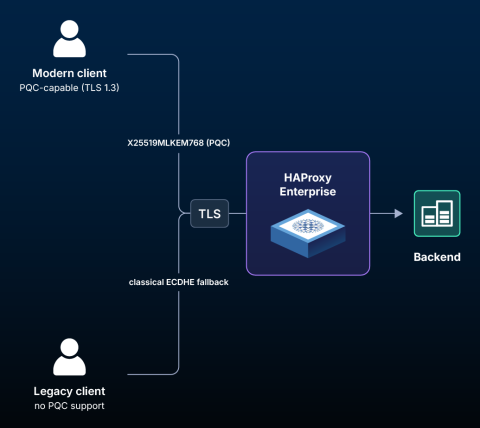
Curve negotiation: PQC first, with graceful fallback
Post-quantum public keys and ciphertexts are significantly larger than their classical counterparts. ML-KEM-768 keys are roughly 1,184 bytes; a classical X25519 key share is 32 bytes. This increases the size of the ClientHello and ServerHello packets, which can push them past a single network packet.
For most applications this is a non-issue, but if you're running latency-sensitive workloads or environments with strict MTU constraints, it's worth testing before rolling out broadly.
Added to the frontend bind line, this directive rejects TLS connections whose SNI doesn't match a configured certificate. In a harvest-now-decrypt-later context, it's a relevant hardening step. It ensures HAProxy terminates TLS only for domains you explicitly control, reducing the attack surface for traffic collection. It was introduced in HAProxy Enterprise 3.2r1.
Testing the connection
You can verify hybrid PQC is negotiating correctly with BoringSSL's bssl client, which ships with HAProxy Community and HAProxy Enterprise packages by default. The path varies by version (this example uses HAProxy Enterprise 3.2), so adjust accordingly:
| printf "GET / HTTP/1.1\r\nHost: haproxyrocks.com\r\n\r\n" | \ | |
| /opt/hapee-3.2/usr/bin/bssl s_client \ | |
| -curves SecP256r1MLKEM768 \ | |
| -connect 192.168.0.1:443 |
A successful connection shows the negotiated group in the output:
| Connecting to haproxyrocks.com:443 | |
| Connected. | |
| Version: TLSv1.3 | |
| Resumed session: no | |
| Cipher: TLS_AES_128_GCM_SHA256 | |
| ECDHE group: SecP256r1MLKEM768 | |
| Signature algorithm: rsa_pss_rsae_sha256 | |
| ... | |
| HTTP/1.1 200 OK | |
| content-length: 25 | |
| content-type: text/plain | |
| Hello from HAPEE PQ test |
Note: curl requires OpenSSL 3.5.0 or later for post-quantum hybrid curves — OpenSSL 3.5.0 (released April 2025) is the first version with native PQC support. Older versions require the OQS provider and will otherwise fail or fall back to classical ECDHE. Use bssl for testing.
Once this configuration is in place, your TLS handshake follows a path that classical and quantum computers can't break independently:
| Client + Server → Hybrid Key Exchange → Shared Secret |
Implement post-quantum cryptography now
Quantum computers that can break RSA and ECDHE don't exist yet. But adversaries can and do collect encrypted traffic today against the day when they will. NIST finalized its first post-quantum cryptography standards in 2024, and the ecosystem is moving fast.
HAProxy with AWS-LC gives you hybrid PQC without waiting for clients to catch up. The fallback curve order handles compatibility automatically.
PQC carries a slight CPU penalty once enabled, but for most workloads this trade-off is worth taking. We have benchmarked both standard TLS and PQC-enabled TLS, and will publish the results in a follow-up blog post.
What’s next?
Migrating key exchange now is step one of a two-phase migration. Digital signatures are step two.
Hybrid ML-KEM key exchange protects the key agreement step of the TLS handshake, but TLS also uses digital signatures to authenticate certificates. Those signatures still rely on RSA or ECDSA, which are equally vulnerable to Shor's algorithm.
The NIST PQC standard includes ML-DSA (CRYSTALS-Dilithium) and SLH-DSA for post-quantum digital signatures. Support in certificate authorities and TLS stacks is coming.
One note on scope: HAProxy secures the client-to-edge connection. Traffic from HAProxy to your backend applications travels over a separate connection, and if those backends don't yet support PQC, that leg stays on classical crypto. Enabling PQC at the edge is still the right first step because it's the most exposed connection for passive collection. But a complete migration requires applying the same approach to your backend connections.
Frequently asked questions
TLS 1.2 requires two round-trips to complete the handshake. The server sends its certificate and key exchange parameters after the ClientHello; the client completes the key exchange in a separate step. Static RSA key exchange was permitted, so there was no guarantee of forward secrecy. A compromised private key could decrypt any previously recorded session.
TLS 1.3 folds key exchange material into the ClientHello and ServerHello, completing the handshake in one round-trip. Static key exchange is gone entirely, making Perfect Forward Secrecy mandatory. Configured with hybrid PQC curves (as this post covers), TLS 1.3 also supports post-quantum key exchange.
Glossary
A named combination of algorithms defining how a TLS connection is secured: the key exchange method, authentication algorithm, bulk encryption cipher, and message authentication code. Example: TLS_AES_256_GCM_SHA384. Client and server negotiate which suite to use during the handshake.