
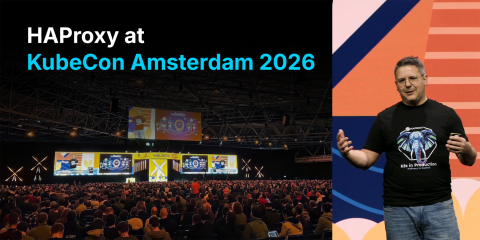
KubeCon + CloudNativeCon Europe 2026 brought thousands of cloud-native practitioners to Amsterdam for four days of talks, demos, and hallway conversations about where Kubernetes is heading. HAProxy Technologies came as a Diamond Sponsor, and by the time the exhibition floor closed on Thursday, it was clear that the market had reached the same conclusion we had. HAProxy is the standard — and this year, more people than ever were ready to say so out loud.
Connecting it all was a single application delivery platform. HAProxy One provides Kubernetes routing, AI traffic management, sovereign security infrastructure, and unified mesh connectivity, all from one place. Here's what happened.
Watch our on-demand webinar: Life after Ingress NGINX: how to unify Kubernetes traffic in one stack.
Three conversations the ecosystem needed to have
Three themes surfaced in nearly every conversation: the urgency of replacing Ingress NGINX, the challenge of connecting and securing fragmented multi-cloud estates, and — as AI agents generate unprecedented telemetry — what it actually means to own your observability data. Our three sessions addressed each of them directly.

On Wednesday morning, Jakub Suchy and Zlatko Bratkovic took the demo theatre stage in Hall 1-5 for "Life After Ingress NGINX: How To Unify Kubernetes Traffic In One Stack." With the upstream kubernetes/ingress-nginx project now permanently archived — no further patches, no bug fixes — platform teams are facing a migration they can no longer defer. The session showed a practical path forward: a structured migration to the HAProxy One platform and our Kubernetes solution, handling external load balancing, multi-cluster routing, and service-to-service traffic in one unified stack. The booth traffic afterward confirmed the topic was hitting a nerve.
One piece of that story was the official announcement of HAProxy Unified Gateway 1.0, an open-source Kubernetes Gateway API controller. Conversations across previous KubeCons had made the demand clear, and community beta testing helped shape the 1.0 release. For Zlatko and the engineering team, there was real satisfaction in it: whereas the existing HAProxy Kubernetes Ingress Controller took many iterations to fully expose all of HAProxy's powerful capabilities, HAProxy Unified Gateway delivered them from day one. Enterprise multi-cluster support is coming to HAProxy Fusion later this year.
Thursday morning, Baptiste Assmann, our Director of Product, delivered a keynote in Hall 12 — in front of thousands of attendees — titled "Universal Mesh: Connect and Secure Everything." The argument: the future of cloud-native connectivity is strategically placed gateways at network boundaries, orchestrated by a unified control plane. Universal Mesh is our answer to the cost, complexity, and fragmentation of current multi-cloud and service mesh approaches — a unified model spanning cloud and on-prem, Kubernetes, VMs, bare metal, and everything in between. People were arriving at the booth within the hour to discuss their multi-cloud challenges.
Our third session again featured Jakub as a panelist in a CNCF observability roundtable, covering AI agent behavior and observability as a business capability. Jakub made a point that resonated: "One of the problems of having so much observability data has been that a human just can't read it, but AI can." On data sovereignty, a theme that ran through the whole event, Jakub remarked: "Owning your own data is paramount." More on that below.
"Obviously, everyone is recommending HAProxy"
Many in the audience for Jakub and Zlatko's demo theatre session came to see us afterwards. What they said was striking.
Multiple people said, unprompted, some version of the same thing: "We need to migrate from Ingress NGINX, and obviously everyone is recommending HAProxy." That shift in language — obviously — matters. Not "we heard HAProxy is an option" or "we're evaluating a few tools." Obviously. It reflects a market that has reached a conclusion.

Perhaps the clearest validation of this came when NVIDIA's Run:ai platform — the orchestration layer for AI workloads across GPU clusters. Its v2.24 documentation explicitly recommended HAProxy as the Kubernetes ingress controller for AI production deployments, guiding users away from Ingress NGINX.. That documentation was circulating on the show floor, and it amplified conversations at our booth considerably. For users building on NVIDIA infrastructure, the pieces are already there.
The same theme surfaced independently elsewhere on the floor. A leading cloud infrastructure platform told us that AI factories are rapidly becoming one of their top use cases and reached for the same language we'd been hearing all week: HAProxy as the default proxy for AI inference scaling.
Somebody asked me whether HAProxy is modern enough to take advantage of this moment, given that it's been around for a quarter century now. The answer came easily: it's been modern for 25 years. The properties that make HAProxy the right ingress layer for AI workloads — zero-downtime reconfiguration, stateful connection handling, high-throughput routing under dynamic load — aren't recent additions. They're the reason the internet runs on HAProxy in the first place. AI workloads need powerful, modern traffic management. HAProxy solved the problem years ago.
Connect and secure everything
Baptiste's keynote title captured two essential questions that came up all week.
How do I connect everything in a way I can actually manage?
How do I secure it without handing my traffic to a third party?
In practice, they're two sides of the same problem. They both reflect a need for greater control over complex infrastructure. In both cases, the answer is HAProxy One.

At the demo stations, the Universal Mesh conversations centered on a familiar pain. Organizations are running workloads across two or three clouds, with Kubernetes on one side and legacy infrastructure on the other, and no clean way to connect them without custom API gateways, VPN tunnels, and scattered certificate management. Universal Mesh addresses this by shifting focus from per-service proxies to strategic gateways at network boundaries: fewer components, consistent policy enforcement, and federation that works across the full estate, not just within a single cluster. Those who saw it in action faced their challenges with renewed hope that these intractable problems are finally solvable.
The security story produced its own kind of reaction. Most visitors assumed that an enterprise Web Application Firewall (WAF) means either a cloud service processing their traffic or an appliance with a license that costs as much as a small engineering team. We'd show them something different: the HAProxy Enterprise WAF solution is entirely self-hosted, touches no external service, does not transmit data, and is available with HAProxy Enterprise at no additional cost.
Then we'd show the benchmark results: the highest balanced accuracy of any WAF tested in an open-source benchmark, outperforming both well-known cloud services and commercial appliance solutions, a result further demonstrated by Infobip's zero false positives. Then we'd show the Roblox proof point: 100 million daily users, no measurable increase in CPU utilization, no measurable latency impact.
At that point, most people would ask us to say it again.
Owning your own data
Sovereign infrastructure came up in many of these conversations, and it connected directly to what Jakub had been discussing in the observability roundtable earlier in the week. Attendees frequently arrived assuming that our control plane (HAProxy Fusion) was a SaaS product and that our intelligent security layers were feeding data back to us. When we explained that the control plane is fully self-hosted and the security layers are entirely private, the reaction was often the same: relief.
European regulation — the Cyber Resilience Act, DORA — is turning data sovereignty from a preference into a hard requirement for many organizations. But the shift runs deeper than compliance. As Jakub put it in the roundtable, customers are actively choosing to take back ownership of their data after a decade of pushing everything to SaaS platforms. HAProxy's architecture meets that requirement by design, which was a major factor driving HAProxy’s leadership in the G2 Spring 2026 Grid® and Index Reports.
Our biggest KubeCon yet
The HAProxy booth was hard to miss, positioned right alongside the booths for Microsoft Azure, Google Cloud, Uber, and NVIDIA. Standing next to the hyperscalers is not just good for the photos. It signals where HAProxy Technologies sits in this market: at the foundations of modern applications and AI.
Demo stations kept our solutions engineers busy from the first morning to the final close, and the queues were proof of real interest rather than free-swag tourism — though we had plenty of that too. We distributed thousands of T-shirts, baby onesies, and Loady plushies!

For years now, we've made a point of prioritizing family-friendly swag and giveaways. Loady, our load-balancing elephant mascot, isn't a marketing exercise. It's a small investment in the next generation of engineers — the kids who are growing up with the apps and games that already run on HAProxy — whether they know it yet or not.
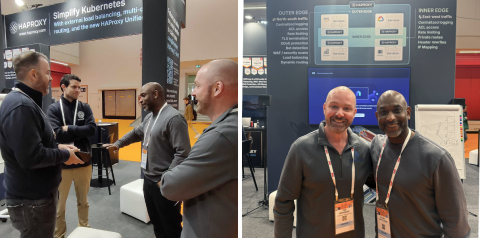
We also had a visit from Kelsey Hightower, who joined us at HAProxyConf 2025 as a keynote speaker and panelist, and who stopped by the booth in Amsterdam to catch up with our team. It was a genuine pleasure and a reminder that the relationships built at HAProxyConf are made to last.
Takeaways from KubeCon Amsterdam 2026
The first takeaway is one that has been building for a long time: HAProxy is the standard for traffic management – any app, any API, and any AI service. When practitioners are telling us "obviously everyone is recommending HAProxy," that reflects the earned recognition of 25 years of reliable performance.
The second is that sovereign infrastructure is the dominant concern for the European market right now. Organizations are actively choosing self-hosted control planes and security over SaaS alternatives, driven by regulation, risk appetite, and hard lessons from a decade of pushing data to external services. HAProxy's architecture is perfectly positioned for this shift.
The third takeaway is about the depth of trust that has grown between HAProxy and its community. Many conversations at our booth weren't first encounters, they were catch-ups with friends. People were sharing stories of when “HAProxy saved my life”, before bringing us their next problem, already trusting that we could help them solve it. That trust runs in both directions. The conversations practitioners bring to events like this one — their problems, their feedback, their honest assessments of what they need — will continue to shape what we build.
Ready to migrate from Ingress NGINX? Use our migration toolkit.
See HAProxy One in action. Request a demo.
Whatever you’re building in 2026, HAProxy was made for this. Join us and seize the moment.
Subscribe to our blog. Get the latest release updates, tutorials, and deep-dives from HAProxy experts.


