Building trust through open source, why model context protocol (MCP) is a gift to the proxy community, and more.
Early in his career, Kelsey Hightower made a bet. The load balancer his team was running was consuming too much memory, and he was convinced he knew the fix. He told his manager: “If it doesn’t work, fire me. But I think I can make it work.” The fix was HAProxy. It was a story he shared publicly for the first time at HAProxyConf 2025, where he delivered a keynote address, “The Fundamentals.”
Hightower has been one of the most thoughtful voices in technology for decades, with significant contributions to open source software, particularly Kubernetes. We were delighted that he accepted our invitation to deliver the keynote address at HAProxyConf 2025, and that he also joined a lively panel discussion later the same day. We’ve drawn on both sessions to share his key insights here.
1. The primacy of fundamentals
Hightower argued that the basis of a valuable career in technology lies in mastering fundamental principles. He warned that some professionals “have no idea why they’re doing what they’re doing. They’re just assigned the Jira ticket, and off they go like little robots.” This can lead to stagnation, so a 20-year career might look more like “20 years of one-year experience.”
Hightower challenged the very notion of “legacy software.” “Let me guess what your company is doing,” he said. “You take data in, do something in the middle, and write it to a database... Most of these fundamentals revolve around that.” Whether code is COBOL, Fortran, or the latest “modern” language, the underlying pattern of data processing remains the same.
“The people who understand the fundamentals tend to be the most creative because they can see the low-level details so they can rearrange things to match whatever they need,” Hightower explained. It’s a capability that’s rarer than it sounds.
Becoming such a creative individual is a strategic blueprint for career resilience. "Those who understand these fundamentals do really unique things to make things work,” he points out. “They build really cool data pipelines. They can manipulate any protocol and translate it to another, kind of like this whole HAProxy thing.”
2. “Understanding” as a first-class product
Hightower sees “understanding” as a first-class product to be created and distributed. He criticizes those who use technical jargon to signal their own expertise: “Sure, you look smart,” he asserts, “but that doesn’t make the other person feel smart.”
Early in his career, Hightower was a junior engineer on a team that was “using a particular popular load balancer at the time, and it was using too much memory per request… I’m in the corner on my laptop, figuring out how to swap out the popular proxy at the time for this little small one, this little ‘HAProxy’ thing.…”
“One day, I bet my career and said, ‘Hey, listen, if it doesn’t work, fire me. But I think I can make it work…’” continued Hightower. He subbed in HAProxy for the load balancer that was burning too much memory. And HAProxy did the job, keeping memory usage consistently low for days on end.
“I think,” he continued, “that’s when I earned my technologist stripes. It wasn’t the fact that I was able to explore new technology. It was the fact that I was able to curate it for the specific use case at hand. And I understood what it meant to put my reputation on the line.”
Later, at Google, he spent six months writing “Kubernetes the Hard Way,” a comprehensive tutorial that forces the user to manually perform every step of setting up a cluster, rather than writing an automation tool. His reasoning: the more people who understood every nuance of Kubernetes, the more creative contributors the project would attract.
3. The “NoCode” manifesto
Presented with any new trend, Hightower’s first question is simple: “Does it provide any value to me?” This ensures that real-world utility wins out over hype.
If a company “makes a billion dollars with three servers”, then “Kubernetes offers zero value to you... SCP (Secure Copy Protocol) is all you need.” For AI, he cautioned against “jumping to a complex and expensive large language model (LLM) to analyze structured data that could simply be put in a database.” Look for an efficient library to, for instance, convert JSON to XML; using an LLM is simply “wasting your money.”
Hightower has built a satirical GitHub repository called NoCode to make the point. The theme: “The best way to write secure and reliable applications is to write nothing, deploy anywhere.” The project’s contribution guide clearly states, “All changes are welcome as long as no code is involved.” NoCode is so popular that engineering directors have even asked him to take it down because of the “distractions it’s been causing their team.”
Practitioners should leverage existing, battle-hardened solutions rather than reinventing the wheel. HAProxy is a prime example: “If you see someone implementing, like, proxy features, you say, hey, there’s this thing called HAProxy. You can put it there, and it does all of these things that you have on the roadmap.”
4. Don’t become a “junior human”
Hightower asserts that technical excellence is inseparable from personal growth, intellectual curiosity, and empathetic human interaction. When he achieved the title of Distinguished Engineer at Google, others asked how to follow in his footsteps. In response, he warns: “You don’t want to spend your whole career chasing becoming a Senior or Distinguished Engineer and remaining a junior human being.”
To become a “senior human,” begin with a simple question: “Why?” But intellectual curiosity also requires emotional courage. He points to the vulnerability inherent in a code review: “You know how much courage it takes to submit a PR? Because it’s going to be judged by your peers.” Even a seemingly technical process is steeped in emotion and social risk.
He continued with a challenge to management: “Think about the ways that you kill curiosity in your company, in your team.” This leads to employees who learn to stop trying and just do the “bare minimum not to get fired” — the kind of career stultification that Hightower had warned against.
5. Open source as a relay race
In the open source world, Hightower recommends collective responsibility, succession planning, and direct financial support for projects. Initially, “I thought these projects were about a marathon,” he confesses, “like I will be running this race forever, and I only needed to learn to pace myself.” This approach leads to burnout and project abandonment.

“Now I believe that that’s false. It’s more of a relay race,” he continued. “You need to be thinking about who you will hand that baton to.” He had begun the confd project to solve a specific problem in Docker, but “it wasn’t very extensible.” When HashiCorp built a competing project, Consul Template, Hightower felt not upset, but validated. He had witnessed his idea outgrow him.
Hightower then made an unambiguous case for funding. “If we want these projects to exist, you have to be willing to pay for them,” he states plainly. In the “relay race” model, all participants, including users, have a role to play.
6. The new shape of automation
Hightower said that the move from imperative, script-based automation to declarative, intent-based systems changes the very nature of an engineer’s work and the requirements for security and observability. In the imperative model, the engineer tells the system how to do something. In the declarative model, the engineer tells the system what they want, and the system figures out how to achieve it.
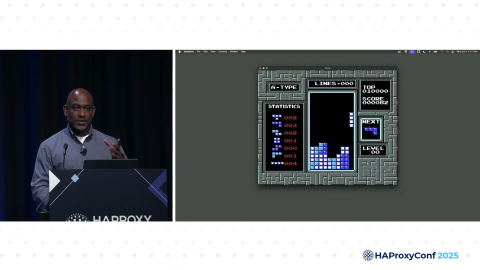
Because automated systems can scale problems just as fast as they scale solutions, Kelsey argues that the real key to modern infrastructure isn't perfect automation, but correlation.
He describes the introduction of the “trace ID” in microservices as a “revolution” because it acts as the digital paper trail for automated actions. By passing a trace ID through the entire stack, engineers can link a downstream effect (such as a slow query) back to the specific upstream intent that triggered it — transforming hours of manual troubleshooting into a simple search for the root cause.
7. MCP as a “gift to the proxy community”
Hightower sardonically frames model context protocol (MCP) as “a gift to the proxy community.” He argues that AI, rather than making established technologies obsolete, is creating an opportunity for mature, fundamental tools such as proxies to reassert their value.
He notes that AI is “not a cheap thing to run,” with costly GPU cycles and high electricity consumption. MCP — the emerging standard for letting LLMs call external tools — is not a “new magical construct,” but a simple API that uses existing technologies such as HTTP and JSON-RPC.
“Let’s not pretend we’re talking about a whole new paradigm,” he states clearly. “People are starting to make the same mistakes because they forgot the fundamentals.” The MCP specification has “nothing about permissions. There’s nothing about headers. There’s nothing about exchange and scope tokens we’ve been doing for 20 years.”
The immaturity and lack of security of the nascent AI/MCP ecosystem is a “gift to the proxy community… If you try to use it as is, you’re going to be in the news — for the wrong reasons.” A mature proxy can be placed in front of an insecure MCP endpoint to provide the authentication, authorization, rate limiting, and input validation that the protocol itself lacks.
The enduring power of “why?”
Many of the insights Hightower shared flow from a single, foundational practice: the relentless asking of “Why?”
Why does this system work the way it does? Why does this community matter? Why are we repeating old mistakes with new technology?
The result is a commitment to curiosity, to critical thinking, and to the first principles that govern not only software, but also people’s professional lives. Stepping back from the “how” of the daily Jira ticket and connecting with the “why” that drives one’s work is not a distraction; it’s actually the most valuable work we can do.
Hightower’s themes — mastering fundamentals, building trust through open source, using the right tool for the job — are ideas HAProxy has been building on for over two decades. The emerging AI and MCP landscape is the latest test of those principles. If you’re thinking about how to secure and govern AI traffic in your infrastructure, explore how HAProxy One addresses the AI gateway challenge.
Subscribe to our blog. Get the latest release updates, tutorials, and deep-dives from HAProxy experts.