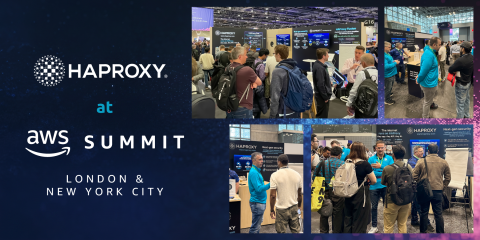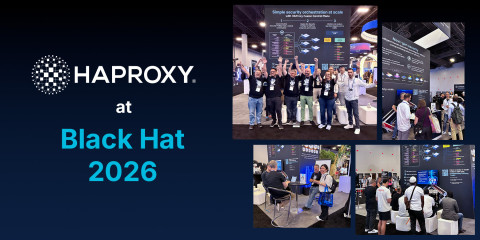
Black Hat USA 2026 brought more than 20,000 people to Mandalay Bay in Las Vegas. We were there as a Platinum sponsor at booth 4208, and across two days on the business hall floor we had more than 750 conversations with security engineers and architects.
Almost every one of them, whatever it started as, turned into a version of the same question: how do I know? How do I know whether a vendor's AI does what the banner says? How do I know what my agents are doing on the network? Or that every certificate in the inventory will renew before it expires, or what's really running in front of my applications right now?
Verification, not novelty, was the subject of the show.
Our takeaways
AI saturation has produced buyer skepticism, and skepticism rewards checkable claims. When every vendor says the same thing, the advantage goes to whoever can be verified, in source code, in documentation, and in practice.
The dominant AI security question has shifted from "what can AI do for us" to "how do we control what our AI is doing." Agent and model traffic needs a policy enforcement point, and that's a proxy problem.
Smaller rooms help build trust. Some of our best conversations happened at a 250-person forum convened by Major League Baseball at the same time as Black Hat.
Six themes from the Black Hat show floor
1. Every booth claimed AI, and the crowd was skeptical
Every vendor at Black Hat attached AI to its message. Some were selling ways to secure AI workflows. Others were selling AI that does the security work for you, reading logs or running penetration tests. AI saturation produced a predictable reaction: attendees told us their hardest problem was separating useful capability from marketing noise.
It's a change in tone from 2025. Last year the question was what can AI do for security? This year: how do I tell whether yours does anything real? Several people asked, more or less directly, to be shown rather than told.
The correction favors technology whose claims can be tested and verified. HAProxy's core is open source, with a documented configuration language, so an engineer can read what a feature does instead of trusting a marketing headline. Behind the project is a community large enough to have tried nearly every configuration imaginable, in production Many of them publish their setups and experiences in blogs and forums.
Open fundamentals raise the bar for everyone, us included. If the core is free, capable, and readable, then commercial products must add something unique and worthwhile: advanced security, management and orchestration, and support from the engineers who built the product.
2. People wanted proof, from someone who had built it
Blocking unwanted traffic and web attacks was the most common use case attendees raised. Our best answer to this was to walk through the security control plane in HAProxy Fusion at one of our demo stations.
Centralized DDoS protection, bot management, and WAF policy across a whole fleet is easier to show than to describe. It’s simple to understand and configure using HAProxy Fusion’s Security Profiles and the intuitive visual policy builder we call the Threat-Response Matrix. To cap it all, unified observability shows its impact on real traffic.
Attendees wanted to go deep, with multiple technical questions, so it helped that we brought several of our top engineers who helped design and build our solutions, and implement them in real-world deployments. At a show where every banner claims the same capabilities, that expertise and experience is the fastest way to stand out.
3. Agent and MCP traffic is the new perimeter question
Some of the most common AI questions were about securing AI traffic. How do you put a policy enforcement point in front of model and agent calls? And how do you see what those agents are doing on the network once they're running?
Businesses are also starting to consume third-party MCP (Model Context Protocol) servers, and some are preparing to expose their own. Both directions raise questions, such as who may call this, and what did they ask for? At least one vendor on the floor was building an MCP gateway as its entire product.
A head of AI security at a large organization sought us out to ask what we can do to help. Our answer: this is a proxy problem in new clothes.
Agent and model traffic is HTTP and gRPC. Authentication, authorization, rate limiting, request inspection, routing, and observability at Layer 7 are among the very fundamentals of HAProxy. You don't need a new category of product to put a control point in front of an agent or MCP server. The control point you already have just needs to see that traffic.
4. Certificate management is as vital as threat protection
For a conference built on offensive research, a striking share of the practical questions at our booth were about certificates. How do you automate issuance and renewal across thousands of endpoints, and what breaks when certificate lifetimes shorten?
There's a deadline behind those questions. Under CA/Browser Forum ballot SC-081v3, maximum TLS certificate lifetimes fell from 398 days to 200 in March 2026. They drop to 100 days in 2027, and to 47 days in 2029. Domain validation reuse is shrinking on the same schedule, from 398 days to 10, so revalidation becomes near-continuous.
It’s worth considering how that will affect your own inventory. A certificate that previously needed to be renewed once a year will need it roughly eight times a year at 47-day validity. An inventory of 500 certificates, for example, becomes close to 4,000 renewal events a year.
These are unglamorous problems that quietly consume large teams.
HAProxy's SSL/TLS implementation is best in class. But certificates aren't a single load balancer problem, they're a fleet problem; managing them consistently across an entire fleet is the hard part. Centralized ACME support in HAProxy Fusion, for fleet-wide certificate automation, is coming soon, and we demoed it at the booth. Automating renewal from the control plane removes a whole category of expiry incident. That demo spread by word of mouth and drew people who needed exactly this.
Post-quantum TLS came up too, usually as a sequencing problem: the load balancer, the backend, and the clients are all on different timelines. The load balancer, at least, doesn't have to be the blocker. HAProxy Community Performance Packages and HAProxy Enterprise 3.2+ support hybrid post-quantum key exchange natively. Clients that aren't ready fall back to classical ECDHE. Our guide to enabling post-quantum cryptography and TLS termination walks through the configuration.
5. "App sec" and why securing traffic matters
AI wasn't the only thing the floor was selling. A large share of it was application security in the narrower sense: securing the application code itself, rather than the traffic that reaches it.
The two layers answer different halves of the same question. Code analysis tells you what an application should do. The traffic layer tells you what it does under real load, from real clients, including the requests nobody designed for.
The two layers also work on different clocks. Fixing application code takes as long as it takes: a patch, a review, a release, a deployment window. The vulnerability stays reachable in the meantime. A WAF at the proxy layer can block the requests that would exploit the vulnerability; this doesn't fix the code but buys the time to fix it properly. That's a good reason for the traffic layer and the code layer to be part of the same conversation.
6. Trust compounds over 25 years
One topic came up again and again: we have F5, we're having some issues, we're opening conversations with other vendors, and we heard of HAProxy.
There’s a good reason why people gravitate to HAProxy under these circumstances. HAProxy has been in production for more than 25 years, upholding the world’s most demanding applications and inspiring a generation of tinkerers in their home labs. That history is why people arrive at the booth already knowing the name, and already trusting the solution. It's also why "how do I know?" has an easy answer here: check the source, or ask anyone who has run it.
It also means the migration path is well traveled rather than theoretical. DoubleVerify's move from F5 to HAProxy Enterprise is the story we pointed people to most often.
Building an ecosystem in 2026
Two miles from Mandalay Bay, we spent the same days at CTI (Cyber & Technology Innovation). It's a 250-person forum, convened by Major League Baseball rather than by a vendor or a media company.
CTI brings together technology and security leaders from MLB clubs, MLB's parent and sister companies, other sports leagues, and media and entertainment organizations. Those people run comparable infrastructure under comparable pressure: a season-shaped traffic curve, and live events that can't be rescheduled.
The keynote paired MLB's security leadership with a public-sector cybersecurity leader and one of the game's most recognizable managers.
This event format is worth watching. Enterprise buyers with mature technical functions can build their own ecosystems, on their own terms, inviting peers directly instead of waiting for a vendor to broker the introduction.
If your organization runs something like this, we'd like to know.
Demos, Loady, and the next generation
Back at Black Hat, booth 4208 ran four demo stations and five live sessions on rotation. The lineup: multi-layered application security with Security Profiles in HAProxy Fusion, fleet-wide load balancer rate limiting, defending against HTTP protocol attacks, TLS at scale with ACME, and post-quantum TLS termination.
The swag verdict was unambiguous. Everyone loves Loady, our elephant mascot and the most reliable conversation-starter we own. After Loady, the biggest hits were the kids' T-shirts and onesies. A lot of today’s engineers got interested in this stuff young. Hopefully our giveaways for kids and families will help inspire the next generation. Our adult-sized T-shirts also earned a few laughs!
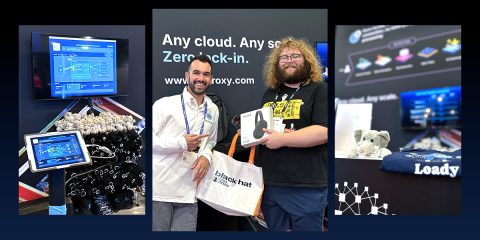
Thank you to everyone who stopped by!
What's next?
See the security control plane in action: watch the HAProxy Fusion 2.0 on-demand webinar.
Get a custom demo and consultation with our experts: request a demo.
Meet us at the next event: HAProxy Events page
Subscribe to our blog. Get the latest release updates, tutorials, and deep-dives from HAProxy experts.