Load balancing as a service (LBaaS) is a solution that enables teams to quickly provision, configure, and remove load balancers from service. LBaaS uses a combination of automation and centralized management (via GUI or API) to scale load balancers up or down based on demand.
Ultimately, LBaaS helps deliver many core benefits of load balancing: traffic distribution, simplified configuration management, easy scalability, and consistent security. While its origins are murky, LBaaS is estimated to have existed in various forms since the 2000s. The solution is relatively uncommon or may be named differently from one vendor to the next.
How does load balancing as a service (LBaaS) work?
LBaaS abstracts complexity away from internal teams. It treats load balancers — or clusters of multiple load balancers — as deployable units that remain accessible to teams with less technical expertise.
Accordingly, this solution helps offload deployment duties from central ops or infrastructure teams while empowering app teams. The entire process gives app teams closer control over their services via intelligent set-and-forget workflows. LBaaS alleviates the burden of continual load balancer management at any scale. It requires minimal input. It also makes it easier to deploy your enterprise load balancer fleet across multi-cloud or hybrid-cloud environments where services are scattered.
While load balancing is primarily a data plane function, LBaaS more closely involves the control plane. It requires a central program or interface with oversight of every deployed load balancer. One or more APIs or a GUI power discoverability across geographical regions and clouds, ensuring applications and associated load balancers are visible. This setup compiles runtime data, configurations, logs, and more from every active instance. Centralization also makes data management and auditing simpler for improved regulatory compliance.
Here's how a load-balancing-as-a-service implementation can work:
App teams use an API call or GUI to request a load balancer with an app-specific configuration.
The control plane — using a combination of automations and some manual settings — provisions that new load balancer in the specified environment.
App teams gain worry-free load balancing, high availability, and security.
The LBaaS team can globally manage, secure, and update any active load balancers as needed.
This entire process aims to be platform-agnostic and rapid. Other teams that might normally carry out these tasks without LBaaS are now free to add value elsewhere.
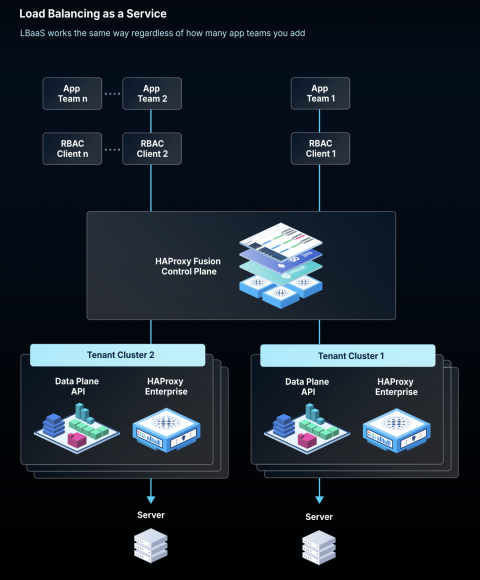
_How LBaaS works in HAProxy using native infrastructure components. _
What are the benefits of load balancing as a service (LBaaS)?
Load balancing as a service offers the following advantages over traditional deployment models:
It reduces overall burden on Ops teams or other teams normally assigned to load balancer management, while cutting down on the quantity of internal tickets.
It allows teams to deploy faster and with less human error — shipping performant, highly available services to end users even faster.
It's more accessible to teams with less technical knowledge.
It's platform agnostic and helps organizations avoid vendor lock-in.
It boosts efficiency through automation and configuration templating.
It promotes stronger, more consistent security across distributed infrastructure components.
You’ve mastered one topic, but why stop there?
Our blog delivers the expert insights, industry analysis, and helpful tips you need to build resilient, high-performance services.
Does HAProxy offer load balancing as a service (LBaaS)?
Yes! HAProxy One delivers advanced LBaaS capabilities to organizations of all sizes and complexity. Our LBaaS solution offloads load balancer management from central Ops teams while making self-service application delivery more efficient for App teams. Making “shadow IT” a thing of the past, HAProxy One unlocks easier administration, advanced security, empowerment, and greater efficiency for teams.
To learn more about LBaaS support in HAProxy, check out our automation and self-service solution or our HAProxy Fusion fleet management presentation.