Connecting services across clouds is hard
Organizations depend on public and private clouds such as AWS, Azure, and Google Cloud to host their critical services. However, managing multi-cloud traffic, performance, and uptime at scale is challenging.
Load balancing is therefore critical, yet many app delivery solutions don't make it easy to route traffic between major cloud providers, limiting your infrastructure options and preventing you from innovating. They also offer poor visibility and connectivity between distributed services.
Multi-cloud networking is growing fast
62% of surveyed IT execs are shifting workloads to the cloud for greater flexibility and scalability.
Visibility gaps cost performance
80% of companies note impactful visibility gaps across their cloud infrastructure.
Too many tools slow multi-cloud management
59% of IT professionals rely on multiple tools to manage their multi-cloud environments.
A true multi-cloud networking security platform with full observability
HAProxy One (encompassing both the data plane and control plane) runs on all major cloud providers. Say goodbye to vendor lock-in and restrictive vertical integration that limits your flexibility.
Distribute external traffic across multiple clouds and datacenters seamlessly, no matter where they're located. HAProxy One ensures your services can access and share data interchangeably without complex networking rules.
Universal Mesh makes it easy for distributed services to communicate with one another for secure and ultra-low latency connectivity.
Build your own global application network, enable APIs to communicate across clouds, deliver end-to-end observability with HAProxy Fusion, and accelerate your multi-cloud vision.
HAProxy One also enforces consistent security policies across every cloud, from SSL/TLS termination to WAF and DDoS protection, so your multi-cloud network doesn't become a security liability.

How multi-cloud networking works
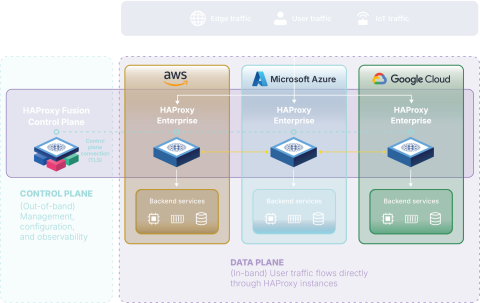
No matter which types of services you're running or where they're hosted, HAProxy One routes traffic between environments without requiring complex networking patterns. HAProxy Fusion (the control plane) seamlessly manages HAProxy Enterprise instances (the data plane) through HAProxy Data Plane API — helping you rapidly deploy in any cloud to securely manage traffic flows.
Why teams network across clouds with HAProxy
Learn how HAProxy One makes it easier to connect to clouds and create a more flexible app delivery infrastructure.
Unify multi-cloud and multi-team networking
HAProxy Fusion gives you centralized control over traffic management across load balancing clusters, clouds, and services. Knock down infrastructure siloes with consistent configuration and complete visibility.
Accelerate time to market
Launch and integrate new services rapidly, while ensuring they can seamlessly communicate. Harness our Universal Mesh architectural pattern and get connected across any combination of clouds, no vendor-specific logic required.
Achieve full observability
Access HAProxy Fusion's end-to-end observability features via a modern GUI or API. Troubleshoot faster no matter where issues reside, with access to rich runtime metrics and detailed logging.
Slash latency across distributed services
Delight your customers and internal teams by building apps that are more responsive — no matter where your services or users live. Slash latency and build seamless experiences.
Get Kubernetes-native, multi-cloud networking
Kubernetes app routing across multiple clusters, in any cloud. Automate service discovery, routing rules, and traffic policies from a single control plane.
Implement consistent security across every cloud
Enforce WAF policies, rate limiting, and SSL/TLS configurations uniformly across public and private clouds. One security posture across your entire multi-cloud infrastructure. Support your cloud sovereignty journey by meeting unique compliance requirements for each application.

Building bridges across clouds: the PayPal approach to unified business communication
See the presentation
What customers say about networking across clouds with HAProxy?
"HAProxy simplifies networking within our cloud architecture, making it an invaluable component of our infrastructure."
"We soon hit a roadblock, figuring out a uniform solution across all the cloud providers. So that's where HAProxy comes in. We leveraged HAProxy as the core component of our solution. HAProxy provided a unified, multi-tenant solution without reinventing an access pattern for each cloud provider."
Do more with HAProxy One
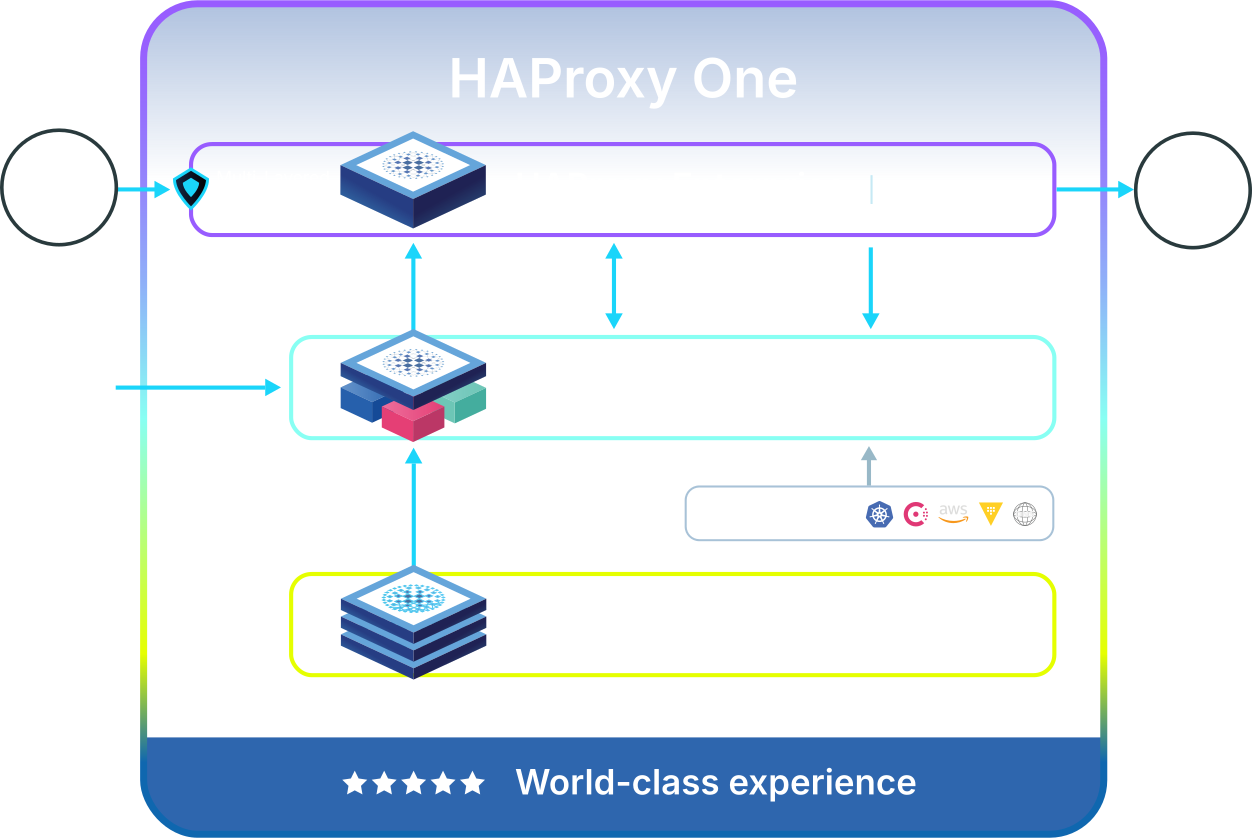
The world's fastest application delivery and security platform seamlessly blends data plane, control plane, and edge network to deliver the world's most demanding applications, APIs, and AI services in any environment.
HAProxy Enterprise
A flexible data plane layer that provides high-performance load balancing, an API/AI gateway, Kubernetes application routing, best-in-class SSL processing, and multi-layered security.
HAProxy Fusion Control Plane
A scalable control plane that provides full-lifecycle management, monitoring, and automation of multi-cluster, multi-cloud, and multi-team HAProxy Enterprise deployments.
HAProxy Edge
A secure edge network that provides a high-capacity global ADN and threat intelligence — enhanced by machine learning — that powers the next-generation security layers in HAProxy Fusion and HAProxy Enterprise.
World-class experience
Award-winning 24/7/365 support from the expert engineers behind HAProxy. We are authoritative on the data plane, control plane, security layers, and the whole networking and Linux stack. We'll do whatever it takes to make your HAProxy deployment a success.
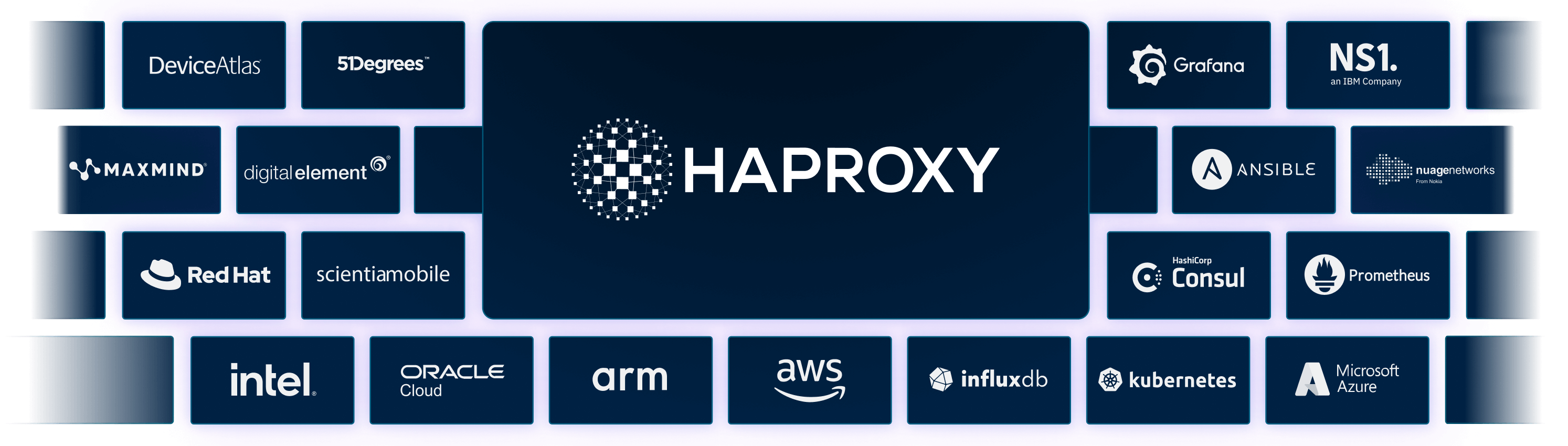
Seamless integrations with essential tech
Ready to connect your services across any cloud?
Take control of traffic management across clouds and build your infrastructure your way with HAProxy One.
FAQs
Multi-cloud networking is the practice of connecting applications, services, and data across two or more cloud environments (such as AWS, Azure, and Google Cloud). It enables seamless traffic routing, service discovery, and observability across all cloud platforms from a single management layer.