
We're excited to announce the release of HAProxy ALOHA 18.5, which gives customers more control over how their appliance behaves under constant change and attack.
UDP load balancing becomes programmable, and whole backends can be published dynamically through the HAProxy Runtime API or the HAProxy Data Plane API. Global Server Load Balancing (GSLB) expands record coverage, consolidating multi-site authoritative DNS directly onto our turnkey hardware and virtual appliances. The integrated HAProxy Enterprise WAF gains configurable inspection limits that tune efficiency under heavy load, with the inspection verdict unchanged.
This release builds on the industry-leading flexibility, performance, security, and resilience that HAProxy ALOHA is known for. All of it runs in line, on customer infrastructure, and inside the perimeter. No traffic leaves for a third-party scrubbing network, and the same configuration language and APIs drive every capability.
What is HAProxy ALOHA?
HAProxy ALOHA hardware or virtual load balancer provides high-performance load balancing for TCP, UDP, QUIC, and HTTP-based applications; SSL/TLS processing; PacketShield DDoS protection; bot management; and a next-generation WAF.
HAProxy ALOHA combines the performance, reliability, and flexibility of our open-source core (HAProxy — the most widely used software load balancer) with a convenient hardware or virtual appliance, an intuitive GUI, and world-class support.
HAProxy ALOHA benefits from next-generation security layers powered by threat intelligence from HAProxy Edge and enhanced by machine learning.
New in HAProxy ALOHA 18.5
Feature |
Benefit |
Impact |
Flexibility | ||
Programmable UDP load balancing | Per-datagram rules to filter, route, track, and rate-limit, plus protocol-aware health checks | HTTP-grade traffic control for UDP traffic such as DNS, RADIUS, NTP, and syslog |
Runtime backend lifecycle | Publish whole backends through the HAProxy Runtime API or HAProxy Data Plane API, with no reload | Dynamic provisioning for high-churn and multi-tenant platforms |
Certificate management with crt-store | Declare, group, and alias certificates and key material once, and refresh them from a remote source | Reduces configuration clutter and simplifies certificate administration across multiple frontends. |
Resilience | ||
Broader GSLB record coverage | TXT, CAA, NAPTR, RDATA, and PTR records, plus a cold-check mode | Multi-site DNS load balancing kept in one stack |
Security | ||
WAF inspection limits and efficiency tuning | Configure Intelligent WAF Engine inspection limits globally or per WAF profile | More efficient inspection under load, with the inspection verdict unchanged |
Optimized buffer size for payload inspection | The WAF and Bot Management modules select the buffer size automatically, so larger payloads are inspected without raising the size for every request | More traffic inspected, with memory use sized to the workload |
XML request body inspection (experimental) | The WAF parses XML request bodies and applies rules for problems specific to XML | Inspection coverage for APIs that accept XML |
Compact WAF logging | A compact binary log format for the WAF (CBOR) | Smaller WAF logs that are faster to process and resistant to format changes |
Separate WAF log destination | WAF logs can be configured to be sent to a different log destination | Security teams feed a SIEM, SOAR, or audit archive without application logs |
Ready to upgrade?
When you are ready to start the upgrade, refer to the installation instructions for HAProxy ALOHA.
Flexibility

Programmable UDP load balancing
UDP services like DNS, RADIUS, NTP, and syslog sit underneath everything else. A reachability check cannot flag when one of these services hangs while the host stays up. Catching it takes checks and rules that understand the protocol.
The goal was to bring UDP services up to parity with TCP and HTTP services in traffic control and health awareness.
HAProxy ALOHA 18.5 makes UDP load balancing programmable. New udp-request content rules act on each datagram: filter traffic, select a server, set variables, track, and rate-limit. A new track keyword adds stick-table counters for UDP and cross-protocol server-status tracking. Protocol-aware UDP health checks confirm DNS, RADIUS, NTP, and syslog services are answering.
Silent UDP failures become detected failures, and traffic moves to healthy servers. Per-datagram rate limiting helps limit targeted UDP abuse directly on the HAProxy ALOHA appliance, without requiring an additional dedicated appliance or complex application-level workarounds.
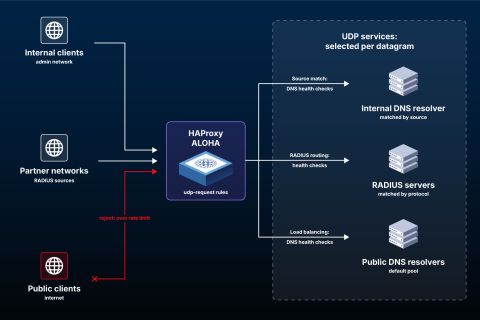
Per-datagram UDP routing and protocol-aware health checks with HAProxy ALOHA
Dynamic backends at runtime
For platforms that update services constantly, i.e. add and remove backends, every change used to require a configuration update. We wanted to remove this operational friction that particularly affects enterprises with multi-tenant platforms, per-customer backends, and CI-driven environments.
HAProxy ALOHA 18.5 creates, updates, and deletes whole backends at runtime, with no reload. It covers full backends, including mode tcp, driven through the HAProxy Runtime API or HAProxy Data Plane API. This capability comes from the open-source HAProxy 3.4 release and is fully available in HAProxy ALOHA 18.5.
High-churn platforms can now publish and unpublish backends dynamically using the same APIs they already use to automate HAProxy ALOHA. This cuts operational overhead and shortens the time needed to bring a new tenant or environment online.
Certificate management with crt-store
HAProxy ALOHA 18.5 introduces the crt-store section, allowing administrators to centrally define, group, and manage certificates and cryptographic keys (such as JWE key material) directly within the configuration. Rather than declaring certificates individually on every frontend, customers can define base directories and assign aliases in one consolidated place. This reduces configuration clutter and operational overhead when managing large pools of certificates on the appliance.
Resilience
Broader GSLB coverage
HAProxy ALOHA Global Server Load Balancing (GSLB) keeps services available across sites and supports disaster recovery. Real deployments need DNS records beyond basic addresses for domain verification, certificate authority policy, telephony, and reverse lookups. Without them, users ran a second DNS system alongside GSLB.
HAProxy ALOHA 18.5 adds TXT, CAA, NAPTR, RDATA, and PTR record types. A new cold-check verification mode also validates GSLB configuration syntax before changes are applied, preventing reload failures when multiple administrators make concurrent updates.
DNS-based global load balancing is now consolidated directly onto the HAProxy ALOHA appliance, reducing external DNS dependencies. Traffic across sites follows current health, not an out-of-date verdict.
Security

WAF inspection limits and efficiency tuning
The next-generation HAProxy Enterprise WAF, included in HAProxy ALOHA and powered by the Intelligent WAF Engine, provides exceptional balanced accuracy of 99.65% and ultra-low latency with 100% local processing. Advanced threat detection powered by threat intelligence from HAProxy Edge, enhanced by machine learning, virtually eliminates false negatives and false positives with almost zero performance impact on legitimate traffic.
HAProxy ALOHA 18.5 builds on this market-leading foundation with improved performance efficiency under heavy load. Inspection limits and tuning options allow enterprises to optimize WAF performance and resource consumption, even under conditions that stress the processing and log-writing capabilities of a typical WAF. All of this is possible without affecting the inspection verdict.
In HAProxy ALOHA 18.5, these controls (including other security features announced in this release) are enabled by tuning the sec-offloader engine. Users configure the inspection limits globally, inline on a single rule, or per WAF profile to bound four things: how many arguments a request carries, how long an argument name may be, how much content is inspected, and how many JSON arguments are read.
Those limits bound what one request can do. They can:
stop processing once a request reaches its match budget
stop capturing matches past a threshold, while still counting them
cap the log lines a single request can produce
Inspection depth no longer has to be set by the strictest application, so a low-risk static site and a high-risk API can be tuned differently on the same appliance. Users can also choose which built-in rules write log lines, and request normalization is more thorough before matching.
If you need assistance configuring and using the security features announced in this release, log in to your account and submit a ticket for guidance from our support team.
Optimized buffer size for payload inspection
HAProxy 3.4 introduced a large-buffer pool in the open-source core. HAProxy ALOHA 18.5 extends it to its integrated security modules, such as the HAProxy Enterprise WAF and Bot Management Module. The modules automatically select the optimal buffer size, so it does not have to be raised globally for every request. Memory use tracks the workload rather than the largest possible request. Body limits stay tunable per WAF profile, so each application gets the inspection depth it needs.
XML request body inspection (experimental)
HAProxy ALOHA 18.5 adds experimental XML request body inspection to the HAProxy Enterprise WAF. The WAF parses XML request bodies as a stream, item by item, and applies rules for problems specific to XML. APIs that accept XML are inspected directly.
The feature ships as experimental in 18.5 and is turned off by default.
Compact WAF logs, separate destinations
The HAProxy Enterprise WAF now supports the CBOR log format. CBOR logs are compact, faster to process, and resilient to format changes.
WAF logs can also go to a different destination from HAProxy ALOHA traffic logs. Security teams typically route WAF logs to a SIEM or SOAR platform, and to a log archive that satisfies their retention and audit obligations. Separate destinations let each stream follow its own retention rules, access controls, and budget. For the basics, see an introduction to HAProxy logging.
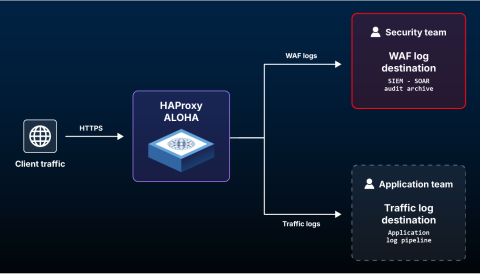
WAF logs and traffic logs go to separate destinations with HAProxy ALOHA
Upgrade to HAProxy ALOHA 18.5
When you are ready to upgrade to HAProxy ALOHA 18.5, follow the links below:
Documentation | Release notes | Installation instructions |
Try HAProxy ALOHA
The world's leading platforms and cloud providers trust HAProxy Technologies to simplify, scale, and secure modern applications, APIs, and AI services in any environment. HAProxy ALOHA 18.5 gives enterprises more control over security, UDP traffic, and runtime changes.
Interested in learning more about HAProxy ALOHA and taking it for a test drive? Request a quote or free trial today.
Subscribe to our blog. Get the latest release updates, tutorials, and deep-dives from HAProxy experts.