
I love TL;DRs, so if you read nothing else from this article, here's mine: AI agents traverse networks in minutes, testing every CVE at once, and no apps, external or internal, are safe. Go back to basics and deploy security in layers.
Two big things happened for me in the last two months. First, in September, we deployed our own internal AI platform at HAProxy Technologies, running an HAProxy-based AI gateway, deploying Kubernetes-based hosted chatbots for every single company employee, and a local sandbox for developers.
Right after that, in October, a lot of new models were released, including Kimi K3.1 Pro and others. Some of these models are clearly less protected against cyber research than others, and the security community, both the good guys and the bad guys, took notice.
CVE explosion in the last 12 months
Check out this chart comparing the number of CVEs published per month; we're looking at a more than 4x increase compared to last year.
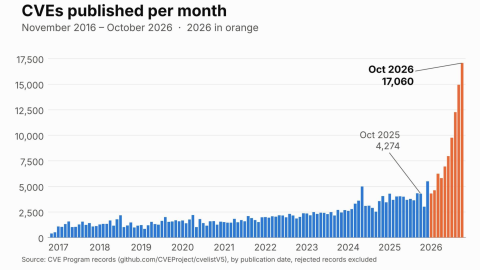
Unfortunately, this trend is not slowing down.
We've also seen some high-profile attacks. The one most emblematic of this new reality was the attack on Binance, the crypto platform.
Back in June, an engineer at Binance searched for an AI coding tool and installed a trojanised Homebrew package from a poisoned result. Binance caught it, swapped the laptop and rotated credentials — but the attacker had already learned who worked on the wallet team. In September, a second engineer sat two fake interviews on a legitimate job platform and was handed a coding 'assignment' that executed on setup. The malware was a 0-day that endpoint protection missed. In October, the attacker used that machine, and one of Binance's own internal AI tools, to pivot onto two more engineers and pick up a deployment token.
From there, everything moved quickly: the actual attack was executed within minutes, with total damage of over $6 billion.
We've seen similar situations at other companies, with many different scenarios playing out:
CVEs are coming faster than we can patch them.
Attackers used to take weeks or months to explore breached networks; AI agents do it in minutes.
Supply chain attacks are still on the rise, effectively punching holes through firewalls and VPNs.
Security in layers
HAProxy has been talking about security in layers for a long time. We usually talk about the L4/L7 layers, but this goes deeper. It is imperative that you:
Patch systems as quickly as you can.
Deploy MDM on all company assets.
Deploy proper L4 firewalls.
Run an L7 web application firewall, with brute-force and scanner detection with it.
Customers often say, "Our apps are internal; we don't need this stuff." My message for them right now is: as of this moment, all apps are external, whether we like it or not. No matter the use case, network, or scope, all apps are at risk and can often serve as springboards for further internal attacks.
BTW, EU DORA + NIS2 require proportionate, risk-based controls... and in practice, a WAF is the easiest way to implement them.
Internal isn't a boundary anymore
With that in mind, here is what I did on our internal AI infrastructure and internal apps:
We deployed our multi-layered securityin learning mode last week
Tuned all rules and false positives
And will now be deploying in enforcement mode
Here is what our Security Profile looks like in HAProxy Fusion Control Plane. If it looks like the profile for external applications, that's the point:
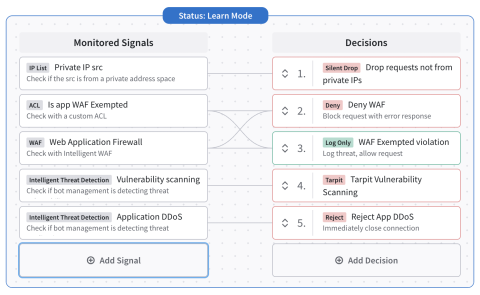
Nothing from outside a private address space gets through. WAF matches are denied unless the app is exempted, and vulnerability scanners get tarpitted. Application DDoS connections are closed immediately.
Your setup probably doesn't look like this. Most internal apps don't have a WAF in front of them at all, let alone a profile that drops anything from outside a private address space.
The gap is the assumption that internal means safe, and that assumption is no longer reasonable.
If you want to close it, don't start with everything. Pick one internal app, put a profile in learn mode in front of it, and read the logs for a week. You'll get false positives, tune them, and then enforce.
Let me know if you need help spinning up the same thing in your own infrastructure!
Subscribe to our blog. Get the latest release updates, tutorials, and deep-dives from HAProxy experts.